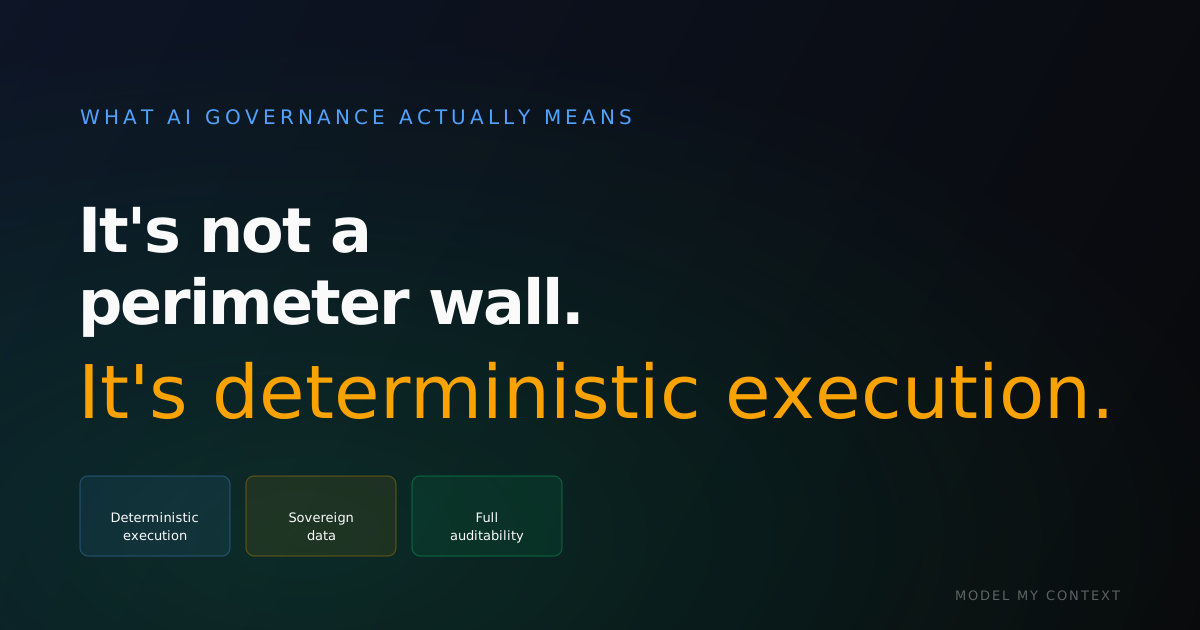
Everyone in the enterprise is talking about AI Governance, but if you look closely at what's actually being implemented, it usually boils down to two things: a restricted corporate policy document that nobody reads, or a software filter that blocks employees from copy-pasting corporate data into web-based LLMs.
That isn't governance. That's a perimeter wall.
True governance isn't about stopping your people from using AI; it's about ensuring that when an autonomous AI agent interacts with your actual business systems, it executes your corporate rules perfectly, every single time. As we transition from the "Internet of Eyes" (webpages built for humans) to the Headless Internet (APIs built for autonomous AI agents), the definition of governance has to change fundamentally.
It must move from a passive checklist to a deterministic, execution-level standard.
The Current Nightmare: "Prompt & Hope"
Most organizations deploying AI today rely entirely on prompt engineering. They write a 500-word system prompt instructing an LLM to "be a helpful insurance claims assistant and strictly follow company procurement guideline X." This is what we call "Prompt & Hope."
Prompts are fragile, opaque, and prone to drift. A model update overnight can change how an agent interprets a sentence, turning a strict compliance check into an optional suggestion. In a regulated environment — whether it's banking, insurance, or healthcare — this lack of predictability is an operational and legal nightmare. If your business rules vary day-to-day based on the mood of a black-box LLM, you don't have a governed process; you have a corporate liability.
The Three Pillars of True AI Governance
To deploy autonomous AI agents safely into business workflows, enterprise leaders — specifically CIOs and COOs — need an architecture that guarantees execution. True governance relies on three non-negotiable pillars:
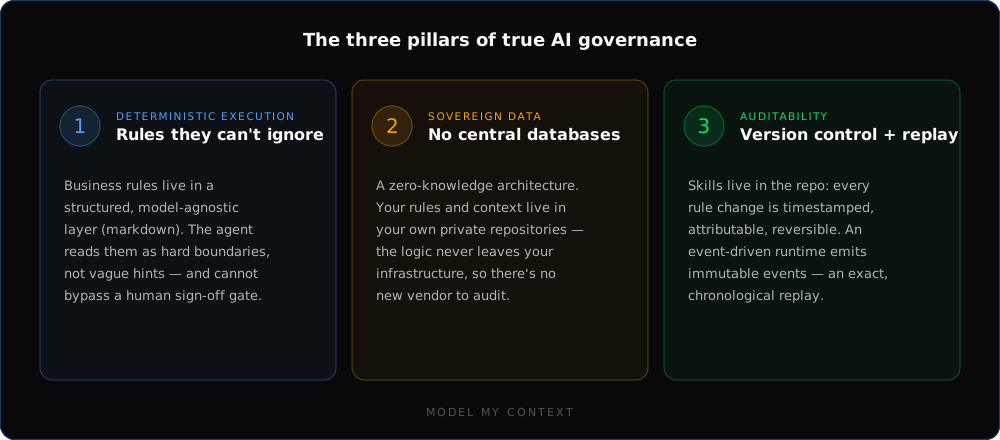
1. Deterministic Execution (Rules They Can't Ignore)
An AI agent should never have to "guess" your procurement thresholds or compliance steps. Governance means separating the intelligence of the LLM from the logic of the business process. By codifying business rules into a structured, model-agnostic layer (such as a standard markdown file), the agent reads instructions as rigid boundaries rather than vague hints. The AI can figure out how to write the response or look up the data, but it cannot bypass a requirement for human sign-off if an invoice exceeds a specific threshold.
2. Sovereign Data Ownership (No Central Databases)
You cannot claim to govern your AI if you surrender your internal business logic and customer data to a third-party vendor's central database. True governance requires a Zero-Knowledge Architecture. Your business rules and contexts should live where your developers already track code: your own private enterprise repositories. This satisfies enterprise procurement out of the box because your security team doesn't have to audit a new vendor's data storage practices — the logic never leaves your infrastructure.
3. Full Version Control and Auditability
If an AI agent makes an automated decision, you must be able to trace exactly why it made that decision. By leveraging native repository storage for AI skills, you gain an instantaneous, unalterable audit trail. Every change to a business rule is tracked, timestamped, attributable to a specific human author, and fully reversible. If a compliance standard changes, you update the repository, and the open-source execution engine instantly enforces the new reality across all your agents.
Crucially, this design extends from static design-time logic down to real-time execution through an Event-Driven Architecture (EDA). Instead of tracking agent behavior via chaotic, unreadable text logs, every state change, system interaction, and rule evaluation is emitted as a discrete, immutable event at runtime. Because this event-stream acts as the final source of truth, your security teams can audit live operations without intrusive probing. If an agent hits a specific threshold or triggers a boundary condition, the execution engine registers it instantly as an immutable event record, allowing for precise replayability. You don't just know what your rules were; you possess an indisputable, chronological replay of exactly how your agents reacted to those rules at runtime.
Enforce the Reality
The era of experimenting with standalone AI prompts is drawing to a close. As organizations scale up to deploy complex agentic workflows, the winners won't be those who wrote the cleverest prompts. The winners will be the organizations that built a robust, auditable infrastructure capable of enforcing corporate intent at scale.
AI governance isn't a restriction on innovation. When done right, it is the ultimate enabler — giving your business the trust and safety it needs to finally take the training wheels off enterprise AI.
To see how to execute on this architecture using open-source engines and standard file structures, explore Model My Context.
Related reading