The API price war has officially ended. Google I/O 2026 marked a significant architectural shift: we have moved beyond the era of the text-chat assistant. With platforms like Antigravity, the new industry standard involves deploying massive, autonomous multi-agent networks executing complex pipelines at minimal cost.
But as engineering teams rush to orchestrate dozens of concurrent agents, they hit a substantial bottleneck — context rot.
Why the swarm breaks
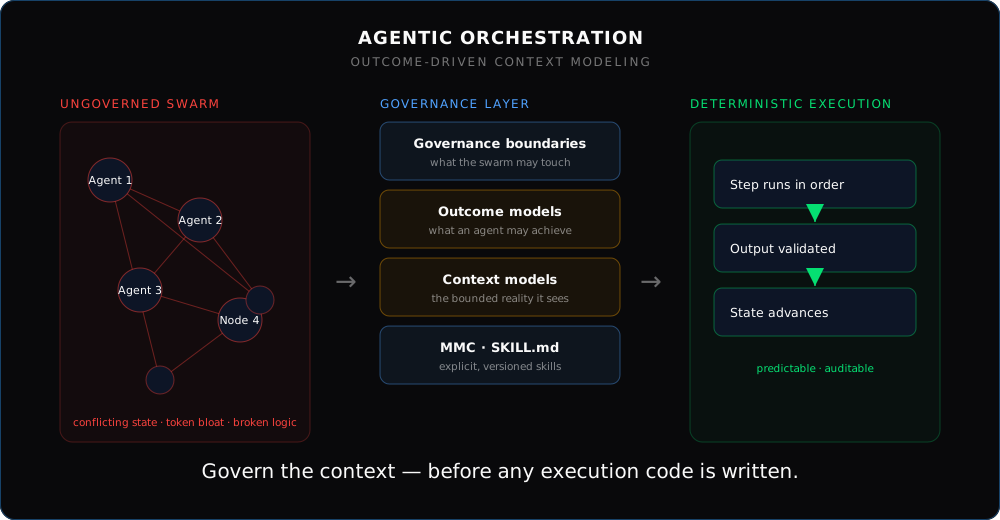
When you deploy 50 autonomous agents on legacy API layers or flat file structures, efficiency collapses. You get conflicting states, token bloat, and broken logic. The more agents you add, the worse it gets, because none of them share a governed view of what they're allowed to see or do.
In 2026, raw intelligence has become a cheap, disposable commodity. The true technical advantage lies not in the model itself, but in how we govern the context within which these models operate. That requires a shift away from traditional event tracking toward Outcome-Driven Context Modeling.
Decouple the logic from the model
To build resilient agentic systems, you have to decouple business logic from the underlying model. A standardized, headless framework is essential to explicitly define two things:
- Outcome Models — what an agent is dynamically authorized to achieve.
- Context Models — the exact, bounded reality an agent is permitted to access.
Get those two right and the swarm stops fighting itself: every agent operates inside known boundaries, toward a defined outcome, on a minimal slice of context.
How MCP makes it concrete
By using the Model Context Protocol (MCP), we can replace traditional, brittle website interfaces with clean, headless contextual endpoints tailored for machine consumption.
At Model My Context, we've dedicated recent months to exactly this. The MMC Workbench, combined with our open-source MMC MCP Server, gives architects a comprehensive mission-control layer. It lets you:
- Model agent boundaries — the governance perimeter the swarm operates inside.
- Map AI skills explicitly through structured
SKILL.mdfiles — versioned, reviewable, human-owned. - Prevent multi-agent chaos before any execution code is written — the boundaries exist first.
This is the inversion the swarm needs: instead of agents discovering the application surface at runtime and improvising, they pull bounded context and authorized outcomes from a governed layer.
The 2026 reality
If your 2026 strategy depends on letting agents operate without a deterministic context framework, you are not scaling effectively — you are accumulating architectural debt.
The future is not just agentic. It is outcome-driven and strictly modeled.
At Model My Context, we build the open-source MCP infrastructure and the MMC Workbench that let architects govern agent boundaries, outcomes, and context before a line of execution code is written. Explore the Workbench to model your swarm instead of fighting it.
Related reading