The enterprise technology world is currently trapped in a race for raw horsepower.
Every week, the industry benchmarks a new foundational model boasting larger parameter weights, faster token generation, and massive context windows. The message from Big Tech is clear: the path to automation lies in building a bigger, stronger AI stallion.
But organizations attempting to deploy these models into production are hitting a wall of diminishing returns. The reality confronting software architects is stark: an unbroke, bucking horse is magnificent to watch, but it is entirely useless for pulling a cart.
When you try to strap critical business operations directly onto the back of a raw, probabilistic Large Language Model (LLM), you don't get automation. You get hallucination whiplash, unpredictable state changes, and crippling token bleed.
The issue isn't that the models aren't "smart" enough. The issue is that we are trying to use an untamed oracle as a deterministic application tier.
The Illusion of AI-Native Orchestration
As these stability issues have become obvious, AI providers have attempted to build their own guardrails. We are seeing a massive surge in "AI-native orchestration"—features like built-in Claude workflows, native agentic loops, and model-side routing configurations.
On the surface, these features promise a solution to the chaos. They let you chain prompts together, build visual conditional branches, and manage state entirely within the AI's ecosystem.
But AI-native orchestration doesn't solve the problem; it just moves the problem up a layer.
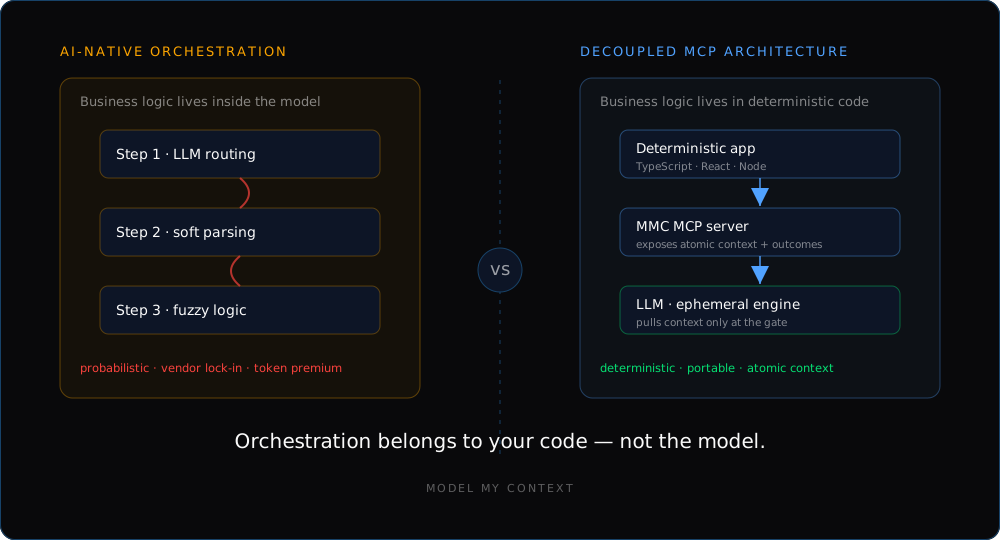
When you rely on a model-provider's native workflow suite to handle your business rules, you are still building on a probabilistic foundation. A workflow orchestrated by an AI native environment still relies on LLM routing, soft parsing, and fuzzy logic to move from one step to the next.
If the underlying engine experiences attention drift, your entire execution sequence can derail. Furthermore, locking your core operational logic into a specific provider's native ecosystem creates severe vendor lock-in, hides your business rules inside opaque model behavior, and still charges you a massive token premium to handle simple routing that standard software should execute for free.
Chaining three bucking horses together with a loose rope doesn't make a stable carriage. It just gives you three times the unpredictable energy to manage.
The Failure of the 2,000-Word Prompt
Before these native workflow tools arrived, the default response to a failing model was simply writing a longer, more exhaustive prompt. We piled on system instructions, few-shot examples, and edge-case exceptions, stretching context windows to the breaking point.
This remains the architectural equivalent of whispering gentle instructions to a horse mid-buck.
Prompt engineering is a fragile, anti-pattern abstraction layer. It treats the model as a black box that can be coaxed into obedience if we just find the magical combination of words. In production, this approach fails for three reasons:
- Token Bloat: Carrying massive instruction sets in every single API call degrades latency and creates compounding operational costs.
- Attention Drift: As prompt length increases, the model's retrieval-augmented attention degrades, causing it to miss critical constraints mid-execution.
- Probabilistic Leakage: No matter how well-engineered a text prompt is, a raw model remains probabilistic. It cannot natively guarantee a deterministic state change.
To achieve enterprise-grade reliability, we must stop trying to tame the model through text manipulation or native model-side scripting. We must build a structural harness around it.
The Anatomy of an Operational Harness
An operational harness doesn't diminish the raw computational power of an LLM; it constrains and directs it. It shifts the burden of control from the English language (the prompt) to structural software engineering (the architecture).
By building an outcome-driven architecture, we isolate the probabilistic engine inside a deterministic framework. This harness relies on three core architectural components:
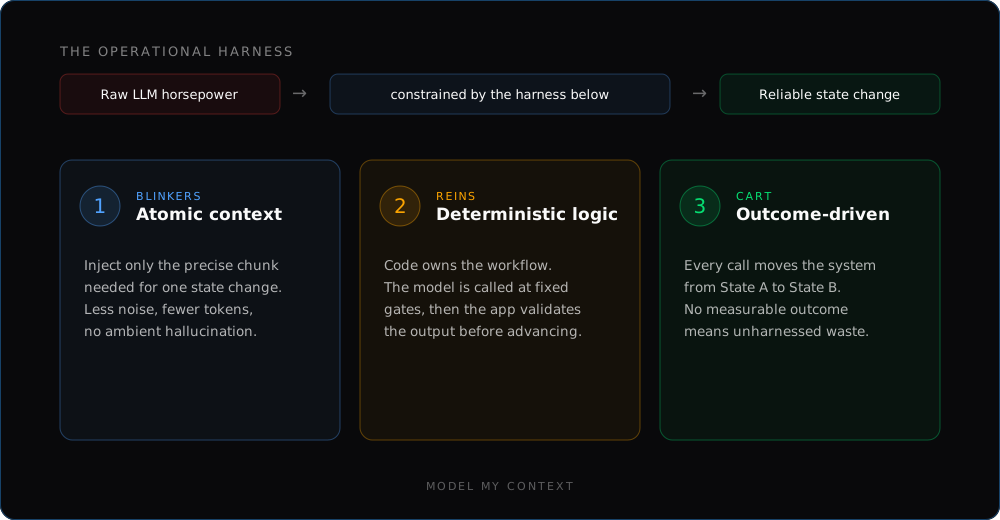
1. The Blinkers: Atomic Context Boundaries
If you give a horse a 360-degree view of a chaotic environment, it gets spooked by side distractions. Similarly, if you flood an LLM with an entire relational database or a massive file directory, it loses focus and hallucinates.
Instead of expanding context windows, we must radically restrict them. The harness must isolate and inject only the precise, atomic chunk of context required to execute a single, immediate state change. By stripping away structural noise, you radically reduce token consumption, eliminate ambient hallucinations, and force the model to operate on clean data.
2. The Reins: Deterministic Application Logic
The horse provides the raw kinetic energy, but the rider retains absolute control over the route. The model should never design, manage, or orchestrate the business workflow.
Orchestration belongs entirely to fixed, deterministic code execution environments—utilizing a professional technology stack like TypeScript, React, and Node.js. The AI is treated simply as an ephemeral runtime engine, called upon at explicit, tightly controlled intervals to transform context. The moment the model returns an output, the deterministic application tier pulls the reins back, parsing and validating the state change before advancing the system.
3. The Cart: Outcome-Driven Modeling
A horse does not run simply for the sake of running; its movement is tethered to a mechanical weight to achieve a destination.
We must shift the software paradigm entirely away from "What content can this AI generate?" and move toward Outcome-Driven Context Modeling. Every interaction with an LLM must be modeled as a strict sequence designed to transition a system from State A to State B. If an AI invocation cannot be validated against a measurable business outcome or a structured schema change, it represents unharnessed token waste.
Implementing the Harness: Headless Context Interfaces
How do we build this harness without rewriting our entire software stack from scratch? The answer lies in decoupling our data layers from the models using the Model Context Protocol (MCP).
Instead of building traditional, heavy web structures or relying on proprietary model-side workflow systems, we can implement an open-source MMC MCP Server alongside an architectural MMC Workbench.
This architecture replaces rigid, traditional website interfaces with headless, contextual entry points. The MCP server acts as the physical harness: it exposes highly tailored context models and outcome definitions directly to autonomous agents. The AI agent never sees the broader application chaos; it only interacts with the clean, structured interfaces exposed by the server.
The result is a complete inversion of typical AI integration:
- Push Architecture (Old): Shoving massive prompt data sets into the model and hoping for compliance.
- Pull Architecture (New): The deterministic system uses MCP to allow the model to pull isolated, atomic context blocks only when explicitly required to clear an execution gate.
The Architecture Shift
The future of enterprise AI does not belong to the organizations chasing the largest foundational models or relying on provider-side workflow gimmicks. Foundational AI capability is rapidly becoming a commoditized utility.
The real, defensible value is moving entirely to the software architects who know how to design the best harnesses.
Stop wrestling with unstable prompt strings and fragile model-native routers. Stop paying for bloated, underutilized context windows. Treat generative AI like the raw, chaotic horsepower it is—and build a strict, outcome-driven context architecture to command it.
At Model My Context, we build the open-source MCP infrastructure and development workbenches designed to bridge business logic with deterministic agentic execution. Explore the MMC Workbench and learn how to shift your architecture from prompt-dependence to structural context modeling.
Related reading