
For the inventive mind, the arrival of agentic AI feels less like a new tool and more like a sudden expansion of the self. For those of us who spend our lives bridging the gap between abstract business logic and technical execution, we are entering a "Headless Era." The friction that once slowed down an idea — the weeks spent scaffolding boilerplate or the months lost to manual integration — has evaporated.
But this empowerment comes with a hidden tax: the risk of "God Complex" burnout.
The Velocity Trap
When you can move from a conceptual outcome model to a functional prototype in an afternoon, the dopamine hit is addictive. Inventive people are naturally prone to "hyper-focus," but AI acts as a massive force multiplier for that intensity.
- The Problem: AI doesn't get tired, but the human directing it does.
- The Result: We end up managing a dozen concurrent "Sprints" in our heads, orchestrating AI agents and refining workflows until it's 3:00 AM and we've forgotten to eat.
From "Doing" to "Orchestrating"
The shift from being a builder to a Software Architect of Outcomes is exhausting in a different way. It's no longer about the fatigue of writing lines of code; it's the cognitive load of maintaining the "Context."
When you are using AI to build complex systems — migrating stacks, designing autonomous business proxies, or refining event-driven logic — you aren't just working; you are mapping. You are defining the events, the states, and the skills required for an AI to act on your behalf. This level of high-level architectural thinking requires a mental RAM that most humans aren't built to sustain 24/7.
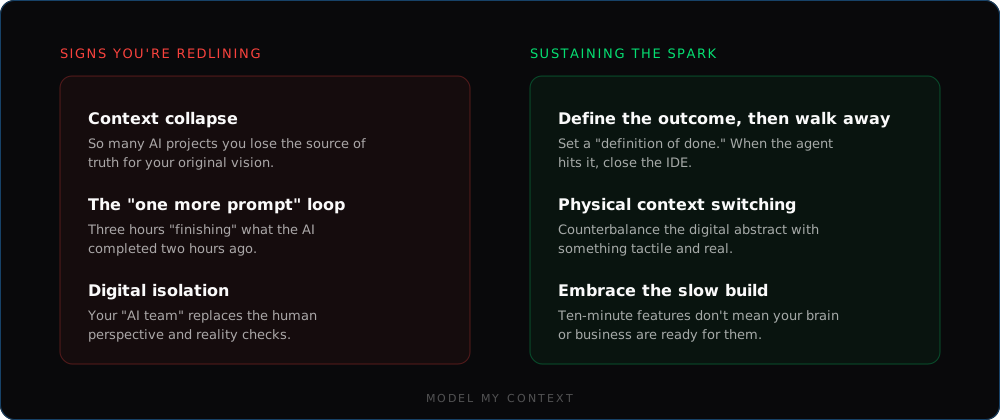
Signs You're Redlining
If you're an innovator riding the AI wave, watch for these specific "system failures":
- Context Collapse: You have so many AI-driven projects running that you start losing the "source of truth" for your original vision.
- The "One More Prompt" Loop: You spend three hours "finishing" a task that the AI actually completed two hours ago, simply because the ease of iteration makes perfectionism feel attainable.
- Digital Isolation: You're so empowered by your "AI team" that you stop seeking the human collaboration that provides necessary perspective and reality checks.
Sustaining the Spark
To keep the inventive fire from turning into a burnout blaze, we have to treat our own energy as the most finite resource in the stack.
- Define the Outcome, then Walk Away: Set a specific "Definition of Done" for an AI session. Once the agent hits the milestone, close the IDE.
- Physical Context Switching: AI lives in the digital abstract. Counterbalance it with something tactile — whether that's tending to land, cooking over an open flame, or manual music production.
- Embrace the "Slow Build": Just because an AI can build a feature in ten minutes doesn't mean your business or your brain is ready to implement it.
The goal of AI isn't to make us work at the speed of light; it's to give us the freedom to think deeply. Don't let the tool that was supposed to set you free become the reason you're tethered to the screen.
How have you been balancing the sudden "superpowers" AI gives you with the need to actually unplug?
Related reading